Concept
TUNED:
- Builds on the outcomes of RefMap and ImAFUSA to advance drone noise, psychoacoustic, and wildlife impact assessment capabilities.
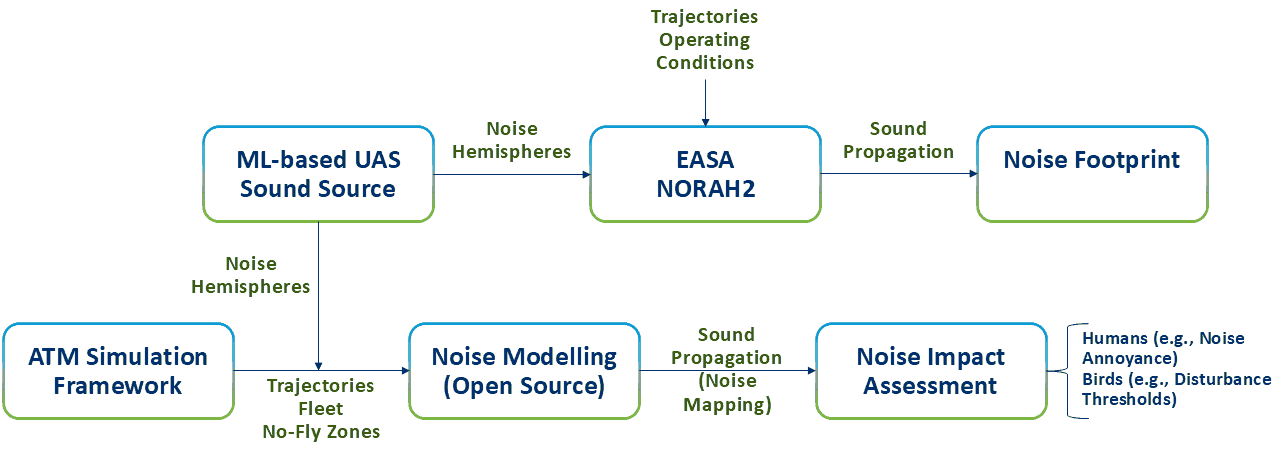
- Provides an integrated toolchain for modelling drone noise emissions and propagation in diverse operating environments.
- Assesses both human impacts (noise annoyance, privacy, visual intrusion, gender-related perception) and wildlife disturbance.
- Enables users to input aircraft type, flight trajectory, and environmental context to generate actionable impact assessments.
- Supports evidence-based decision-making for regulators, policymakers, and industry stakeholders.
- Facilitates the sustainable and socially acceptable integration of drones and other new airspace entrants, aligned with SESAR 3 JU goals on safety, environmental performance, and public acceptance.
Approach
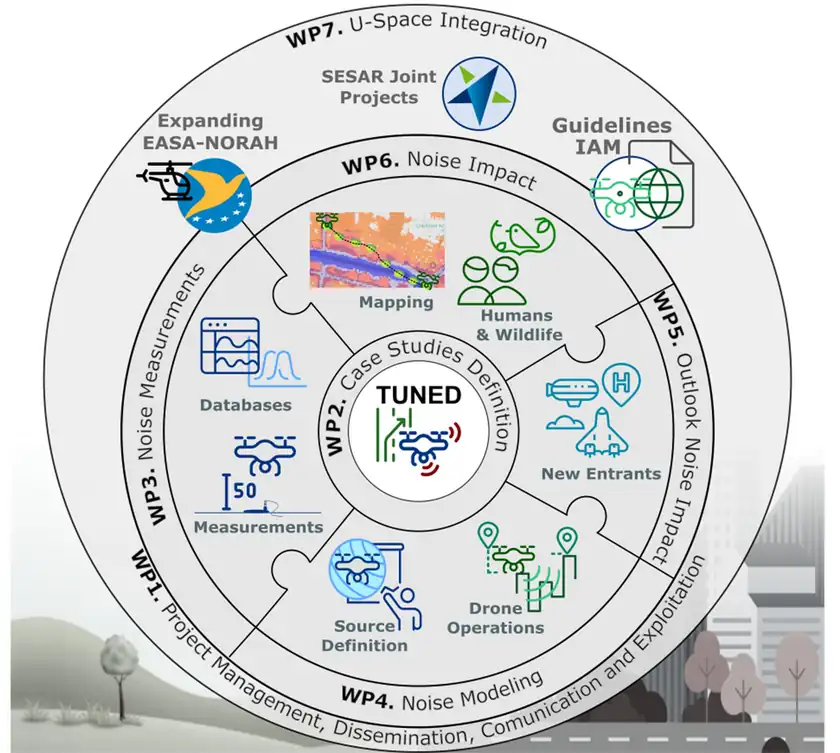
- User-driven and scenario-based methodology: Define operational needs and develop representative use cases (commercial delivery, medical delivery, wildlife monitoring) to guide all subsequent activities.
- Comprehensive drone noise database: Develop standardised measurement protocols and build a drone noise database combining acoustic, flight, GPS, avionics, and weather data.
- Advanced noise prediction models: Develop physics-based and machine learning models to predict drone noise, acoustic characteristics, and noise impacts under diverse operating conditions.
- Integrated impact assessment: Link noise predictions with frameworks assessing both human responses (exposure-response, annoyance, psychoacoustics) and wildlife disturbance.
- U-space and ATM integration: Embed noise assessment capabilities within U-space and air traffic management tools to evaluate operational trade-offs and noise-aware strategies.
- End-to-end decision-support toolkit: Deliver an integrated platform enabling regulators, operators, and policymakers to assess environmental and societal impacts of drone operations.
The TUNED Toolkit
TUNED will develop an ATM-integrated toolkit to assess the noise impacts of drone operations on people and wildlife. The toolkit will be designed so that it can be extended to other future aviation entrants.
The toolkit will support regulators, policymakers, air navigation stakeholders, and drone operators and manufacturers in evaluating operational scenarios and identifying solutions that balance environmental, societal, and operational requirements.
The TUNED Toolkit will be demonstrated with representative operational case studies covering medical deliveries, commercial package deliveries, and environmental monitoring missions.
Toolkit capabilities
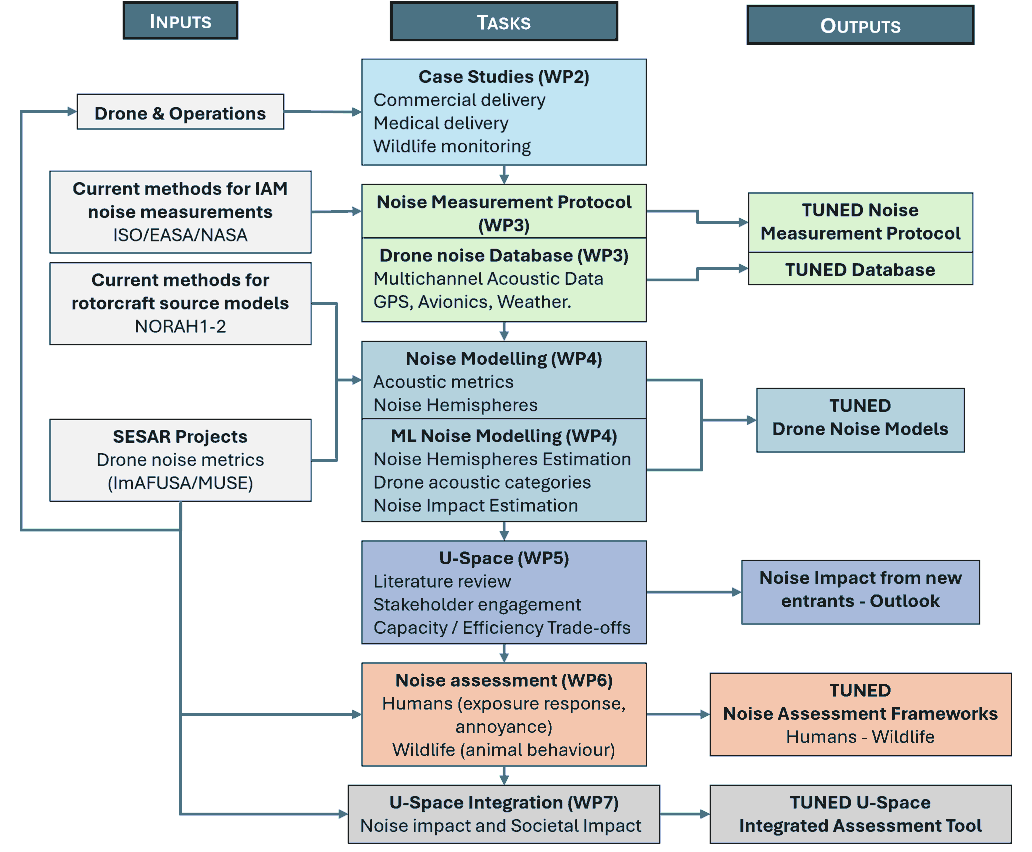
- Drone Noise Data Hub: Provides a harmonised drone noise measurement methodology and access to a high-quality European drone noise database.
- Advanced Noise Prediction: Predicts drone noise emissions across a wide range of aircraft types, operations, and environmental conditions using machine learning models.
- Community Impact Assessment: Quantifies human responses to drone operations, including noise annoyance and perception, using state-of-the-art acoustic and psychoacoustic indicators.
- Wildlife Impact Evaluation: Assesses the effects of drone noise on wildlife through innovative bioacoustic monitoring techniques and evidence from controlled field studies.
- Integrated Decision Support: Combines noise, societal, ecological, and air traffic management considerations within a single assessment platform.
- Trade-off Analysis: Evaluates the balance between environmental impacts, operational efficiency, safety, and airspace capacity to support informed decision-making.
- Noise-Aware U-space Operations: Enables the exploration and optimisation of noise-conscious operational strategies for the sustainable integration of drones into European airspace.
Proposed toolkit structure